2017年6月7日 星期三

week 17

A Midsummer Night's Dream


Characters


  • Theseus—Duke of Athens
  • Hippolyta—Queen of the Amazons
  • Egeus—father of Hermia
  • Hermia—daughter of Egeus, in love with Lysander
  • Lysander—in love with Hermia
  • Demetrius—suitor to Hermia
  • Helena—in love with Demetrius
  • Philostrate—Master of the Revels
  • Peter Quince—a carpenter
  • Nick Bottom—a weaver
  • Francis Flute—a bellows-mender
  • Tom Snout—a tinker
  • Snug—a joiner
  • Robin Starveling—a tailor
  • Oberon—King of the Fairies
  • Titania—Queen of the Fairies
  • Robin Goodfellow—a puck
  • Peaseblossom, Cobweb, Mote, Mustardseed—fairy servants to Titania
  • Indian changeling


Plot

The play consists of four interconnecting plots, connected by a celebration of the wedding of Duke Theseus of Athens and the Amazon queen, Hippolyta, which is set simultaneously in the woodland and in the realm of Fairyland, under the light of the moon.
The play opens with Hermia, who is in love with Lysander, resistant to her father Egeus' demand that she wed Demetrius, whom he has arranged for her to marry. Helena meanwhile pines unrequitedly for Demetrius. Enraged, Egeus invokes an ancient Athenian law before Duke Theseus, whereby a daughter must marry the suitor chosen by her father, or else face death. Theseus offers her another choice: lifelong chastity while worshipping the goddess Artemis as a nun.


Peter Quince and his fellow players Nick Bottom, Francis Flute, Robin Starveling, Tom Snout, and Snug plan to put on a play for the wedding of the Duke and the Queen, "the most lamentable comedy and most cruel death of Pyramus and Thisbe." Quince reads the names of characters and bestows them on the players. Nick Bottom, who is playing the main role of Pyramus, is over-enthusiastic and wants to dominate others by suggesting himself for the characters of Thisbe, the Lion, and Pyramus at the same time. He would also rather be a tyrant and recites some lines of Ercles. Bottom is told by Quince that he would do the Lion so terribly as to frighten the duchess and ladies enough for the Duke and Lords to have the players hanged. Quince ends the meeting with "at the Duke's oak we meet."

In a parallel plot line, Oberon, king of the fairies, and Titania, his queen, have come to the forest outside Athens. Titania tells Oberon that she plans to stay there until she has attended Theseus and Hippolyta's wedding. Oberon and Titania are estranged because Titania refuses to give her Indian changeling to Oberon for use as his "knight" or "henchman," since the child's mother was one of Titania's worshippers. Oberon seeks to punish Titania's disobedience. He calls upon Robin "Puck" Goodfellow, his "shrewd and knavish sprite," to help him concoct a magical juice derived from a flower called "love-in-idleness," which turns from white to purple when struck by Cupid's arrow. When the concoction is applied to the eyelids of a sleeping person, that person, upon waking, falls in love with the first living thing he perceives. He instructs Puck to retrieve the flower with the hope that he might make Titania fall in love with an animal of the forest and thereby shame her into giving up the little Indian boy. He says, "And ere I take this charm from off her sight,/As I can take it with another herb,/I'll make her render up her page to me."


Hermia and Lysander have escaped to the same forest in hopes of eloping. Helena, desperate to reclaim Demetrius's love, tells Demetrius about the plan and he follows them in hopes of killing Lysander. Helena continually makes advances towards Demetrius, promising to love him more than Hermia. However, he rebuffs her with cruel insults against her. Observing this, Oberon orders Puck to spread some of the magical juice from the flower on the eyelids of the young Athenian man. Instead, Puck mistakes Lysander for Demetrius, not having actually seen either before, and administers the juice to the sleeping Lysander. Helena, coming across him, wakes him while attempting to determine whether he is dead or asleep. Upon this happening, Lysander immediately falls in love with Helena. Oberon sees Demetrius still following Hermia and is enraged. When Demetrius goes to sleep, Oberon sends Puck to get Helena while he charms Demetrius' eyes. Upon waking up, he sees Helena. Now, both men are in pursuit of Helena. However, she is convinced that her two suitors are mocking her, as neither loved her originally. Hermia is at a loss to see why her lover has abandoned her, and accuses Helena of stealing Lysander away from her. The four quarrel with each other until Lysander and Demetrius become so enraged that they seek a place to duel to prove whose love for Helena is the greater. Oberon orders Puck to keep Lysander and Demetrius from catching up with one another and to remove the charm from Lysander so Lysander can return to love Hermia, while Demetrius continues to love Helena.

Meanwhile, Quince and his band of six labourers ("rude mechanicals," as they are described by Puck) have arranged to perform their play about Pyramus and Thisbe for Theseus' wedding and venture into the forest, near Titania's bower, for their rehearsal. Bottom is spotted by Puck, who (taking his name to be another word for a jackass) transforms his head into that of a donkey. When Bottom returns for his next lines, the other workmen run screaming in terror: They claim that they are haunted, much to Bottom's confusion. Determined to await his friends, he begins to sing to himself. Titania, having received the love-potion, is awakened by Bottom's singing and immediately falls in love with him. She lavishes him with the attention of her and her fairies, and while she is in this state of devotion, Oberon takes the changeling. Having achieved his goals, Oberon releases Titania, orders Puck to remove the donkey's head from Bottom, and arranges everything so Helena, Hermia, Demetrius and Lysander will all believe they have been dreaming when they awaken. Puck distracts Lysander and Demetrius from fighting over Helena's love by mimicking their voices and leading them apart. Eventually, all four find themselves separately falling asleep in the glade. Once they fall asleep, Puck administers the love potion to Lysander again, claiming all will be well in the morning.

The fairies then disappear, and Theseus and Hippolyta arrive on the scene, during an early morning hunt. They wake the lovers and, since Demetrius no longer loves Hermia, Theseus over-rules Egeus's demands and arranges a group wedding. The lovers decide that the night's events must have been a dream. After they exit, Bottom awakes, and he too decides that he must have experienced a dream "past the wit of man."


In Athens, Theseus, Hippolyta and the lovers watch the six workmen perform Pyramus and Thisbe. The performers are so terrible playing their roles that the guests laugh as if it were meant to be a comedy, and everyone retires to bed. Afterwards, Oberon, Titania, Puck, and other fairies enter, and bless the house and its occupants with good fortune. After all the other characters leave, Puck "restores amends" and suggests that what the audience experienced might just be a dream.
farce


In theatre, a farce is a comedy that aims at entertaining the audience through situations that are highly exaggerated, extravagant, and thus improbable. Farce is also characterized by physical humor, the use of deliberate absurdity or nonsense, and broadly stylized performances. Farces have been written for the stage and film. Furthermore, a farce is also often set in one particular location, where all events occur.


Greyhound Lines

Greyhound Prevost X3-45 (2009 scheme).jpg

Greyhound Lines, Inc., usually shortened to Greyhound, is an intercity bus common carrier serving over 3,800 destinations across North America. The company's first route began in Hibbing, Minnesota in 1914, and the company adopted the name The Greyhound Corporation in 1929. Since October 2007, Greyhound has been a subsidiary of British transportation company FirstGroup, but continues to be based in Dallas, Texas, where it has been headquartered since 1987. Greyhound and sister companies in FirstGroup America are the largest motorcoach operators in the United States and Canada.


Globe Theatre

「Globe Theatre」的圖片搜尋結果

The Globe Theatre was a theatre in London associated with William Shakespeare. It was built in 1599 by Shakespeare's playing company, the Lord Chamberlain's Men, on land owned by Thomas Brend and inherited by his son, Nicholas Brend and grandson Sir Matthew Brend, and was destroyed by fire on 29 June 1613. A second Globe Theatre was built on the same site by June 1614 and closed by an Ordinance issued on 6 September 1642.


A modern reconstruction of the Globe, named "Shakespeare's Globe", opened in 1997 approximately 750 feet (230 m) from the site of the original theatre.[6] From 1909, the current Gielgud Theatre was called "Globe Theatre", until it was renamed (in honour of John Gielgud) in 1994.


The Tempest


The Tempest is a play by William Shakespeare, believed to have been written in 1610–11, and thought by many critics to be the last play that Shakespeare wrote alone. It is set on a remote island, where the sorcerer Prospero, rightful Duke of Milan, plots to restore his daughter Miranda to her rightful place using illusion and skilful manipulation. He conjures up a storm, the eponymous tempest, to cause his usurping brother Antonio and the complicit King Alonso of Naples to believe they are shipwrecked and marooned on the island. There, his machinations bring about the revelation of Antonio's lowly nature, the redemption of the King, and the marriage of Miranda to Alonso's son, Ferdinand.

2017年6月5日 星期一

week 16

【2017年李開復哥大畢業典禮演講:愛,讓人類有別於人工智能】
https://www.facebook.com/kaifulee/videos/1671936116167033/


5 Essential Questions in life


A Midsummer Night's Dream


A Midsummer Night's Dream is a comedy written by William Shakespeare in 1595/96. It portrays the events surrounding the marriage of Theseus, the Duke of Athens, to Hippolyta, the former queen of the Amazons. These include the adventures of four young Athenian lovers and a group of six amateur actors (the mechanicals) who are controlled and manipulated by the fairies who inhabit the forest in which most of the play is set. The play is one of Shakespeare's most popular works for the stage and is widely performed across the world.


Closet Drama

A closet drama is a play that was not written with the intention of achieving a stage production. Most of the time, this form of literature is written for private silent reading or reading aloud among small groups of friends. The topics covered in closet dramas can be quite diverse, but given that many of these plays were written around the same time period, they can have similar themes and styles. Commonly, the closet drama form was used as a way of writing commercially unviable forms of theater.

week 15

Emily Dickinison

Photograph of Emily Dickinson, seated, at the age of 16

Emily Elizabeth Dickinson (December 10, 1830 – May 15, 1886) was an American poet. With the possible exception of Walt Whitman, Dickinson is now recognized as the most important American poet of the 19th century.

Dickinson was born in Amherst, Massachusetts. Although part of a prominent family with strong ties to its community, Dickinson lived much of her life in reclusive isolation. After studying at the Amherst Academy for seven years in her youth, she briefly attended the Mount Holyoke Female Seminary before returning to her family's house in Amherst. Considered an eccentric by locals, she developed a noted penchant for white clothing and became known for her reluctance to greet guests or, later in life, to even leave her bedroom. Dickinson never married, and most friendships between her and others depended entirely upon correspondence. Dickinson was a recluse for the later years of her life.

While Dickinson was a prolific private poet, fewer than a dozen of her nearly 1,800 poems were published during her lifetime. The work that was published during her lifetime was usually altered significantly by the publishers to fit the conventional poetic rules of the time. Dickinson's poems are unique for the era in which she wrote; they contain short lines, typically lack titles, and often use slant rhyme as well as unconventional capitalization and punctuation. Many of her poems deal with themes of death and immortality, two recurring topics in letters to her friends.


Because I could not stop for Death 

BY EMILY DICKINSON

Because I could not stop for Death – 
He kindly stopped for me – 
The Carriage held but just Ourselves – 
And Immortality. 
We slowly drove – He knew no haste 
And I had put away 
My labor and my leisure too, 
For His Civility – 
We passed the School, where Children strove 
At Recess – in the Ring – 
We passed the Fields of Gazing Grain – 
We passed the Setting Sun – 
Or rather – He passed Us – 
The Dews drew quivering and Chill – 
For only Gossamer, my Gown – 
My Tippet – only Tulle – 
We paused before a House that seemed 
A Swelling of the Ground – 
The Roof was scarcely visible – 
The Cornice – in the Ground – 
Since then – 'tis Centuries – and yet 
Feels shorter than the Day 
I first surmised the Horses' Heads 

Were toward Eternity –


Walt Whiteman

Walt Whitman - George Collins Cox.jpg

Walter "Walt" Whitman was an American poet, essayist, and journalist. A humanist, he was a part of the transition between transcendentalism and realism, incorporating both views in his works. Whitman is among the most influential poets in the American canon, often called the father of free verse.[1] His work was very controversial in its time, particularly his poetry collection Leaves of Grass, which was described as obscene for its overt sexuality.


Born in Huntington on Long Island, Whitman worked as a journalist, a teacher, a government clerk, and—in addition to publishing his poetry—was a volunteer nurse during the American Civil War. Early in his career, he also produced a temperance novel, Franklin Evans (1842). Whitman's major work, Leaves of Grass, was first published in 1855 with his own money. The work was an attempt at reaching out to the common person with an American epic. He continued expanding and revising it until his death in 1892. After a stroke towards the end of his life, he moved to Camden, New Jersey, where his health further declined. When he died at age 72, his funeral became a public spectacle.


Phallus


A phallus is a penis, especially when erect, an object that resembles a penis, or a mimetic image of an erect penis.


Any object that symbolically—or, more precisely, iconically—resembles a penis may also be referred to as a phallus; however, such objects are more often referred to as being phallic (as in "phallic symbol"). Such symbols often represent fertility and cultural implications that are associated with the male sexual organ, as well as the male orgasm.

week 14

To the Virgins, to Make Much of Time
BY ROBERT HERRICK

Gather ye rose-buds while ye may, 
Old Time is still a-flying; 
And this same flower that smiles today 
Tomorrow will be dying. 

The glorious lamp of heaven, the sun, 
The higher he’s a-getting, 
The sooner will his race be run, 
And nearer he’s to setting. 

That age is best which is the first, 
When youth and blood are warmer; 
But being spent, the worse, and worst 
Times still succeed the former. 

Then be not coy, but use your time, 
And while ye may, go marry; 
For having lost but once your prime, 
You may forever tarry.


Cronus

Saturnus fig274.png

In Greek mythology, Cronus, or Kronos, was the leader and youngest of the first generation of Titans, the divine descendants of Uranus, the sky, and Gaia, the earth. He overthrew his father and ruled during the mythological Golden Age, until he was overthrown by his own son Zeus and imprisoned in Tartarus. According to Plato, Phorcys, Cronus and Rhea were the eldest children of Oceanus and Tethys.

Cronus was usually depicted with a harpe, scythe or a sickle, which was the instrument he used to castrate and depose Uranus, his father. In Athens, on the twelfth day of the Attic month of Hekatombaion, a festival called Kronia was held in honour of Cronus to celebrate the harvest, suggesting that, as a result of his association with the virtuous Golden Age, Cronus continued to preside as a patron of harvest. Cronus was also identified in classical antiquity with the Roman deity Saturn.


Hypothesis

A hypothesis (plural hypotheses) is a proposed explanation for a phenomenon. For a hypothesis to be a scientific hypothesis, the scientific method requires that one can test it. Scientists generally base scientific hypotheses on previous observations that cannot satisfactorily be explained with the available scientific theories. Even though the words "hypothesis" and "theory" are often used synonymously, a scientific hypothesis is not the same as a scientific theory. A working hypothesis is a provisionally accepted hypothesis proposed for further research.


Carpe diem

'Carpe diem' is usually translated from the Latin as 'seize the day'. However, the more pedantic of Latin scholars may very well seize you by the throat if you suggest that translation. 'Carpe' translates literally as 'pluck', with particular reference to the picking of fruit, so a more accurate rendition is 'enjoy the day, pluck the day when it is ripe'. The extended version of the phrase 'carpe diem, quam minimum credula postero' translates as 'pluck the day, trusting as little as possible in the future'.


Brothers Grimm


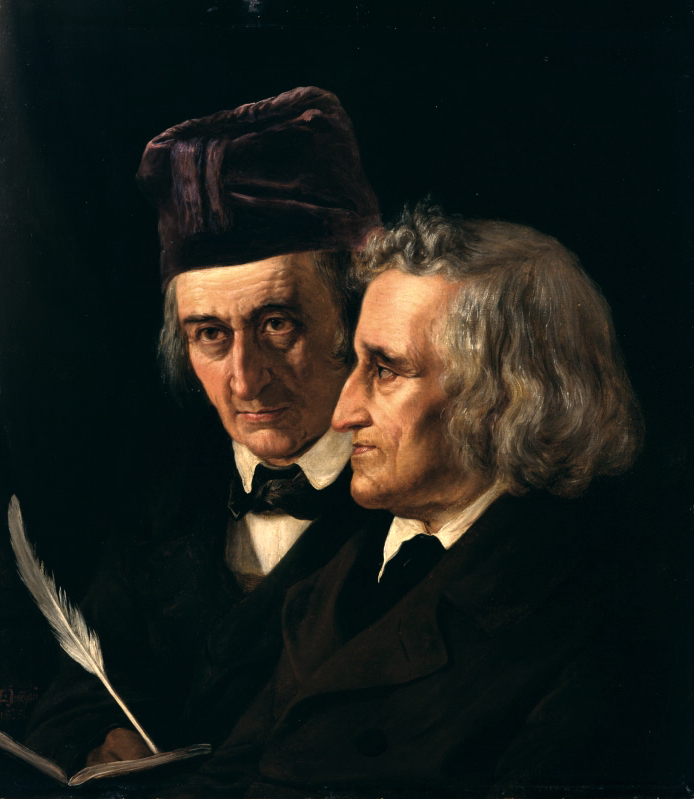
The Brothers Grimm , Jacob (1785–1863) and Wilhelm Grimm (1786–1859), were German academics, philologists, cultural researchers, lexicographers and authors who together specialized in collecting and publishing folklore during the 19th century. They were among the best-known storytellers of folk tales, and popularized stories such as "Cinderella" ("Aschenputtel"), "The Frog Prince" ("Der Froschkönig"), "The Goose-Girl" ("Die Gänsemagd"), "Hansel and Gretel" ("Hänsel und Gretel"), "Rapunzel", "Rumpelstiltskin" ("Rumpelstilzchen"),"Sleeping Beauty" ("Dornröschen"), and "Snow White" ("Schneewittchen"). Their first collection of folk tales, Children's and Household Tales (Kinder- und Hausmärchen), was published in 1812.


The Wolf and the Seven Young Goats


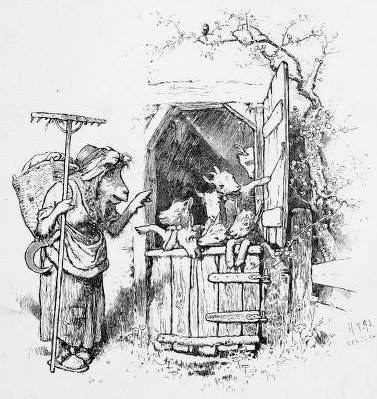
"The Wolf and the Seven Young Goats" (German: Der Wolf und die sieben jungen Geißlein) is a fairy tale collected by the Brothers Grimm, tale number 5. It is Aarne-Thompson type 123, but has a strong resemblance to The Three Little Pigs and other Aarne-Thomspson type 124 folktales, and to the variant of Little Red Riding Hood that the Grimms collected, where she is rescued.

2017年6月2日 星期五

week 13

Ode on a Grecian Urn 
BY JOHN KEATS

Thou still unravish'd bride of quietness, 
       Thou foster-child of silence and slow time, 
Sylvan historian, who canst thus express 
       A flowery tale more sweetly than our rhyme: 
What leaf-fring'd legend haunts about thy shape 
       Of deities or mortals, or of both, 
               In Tempe or the dales of Arcady? 
       What men or gods are these? What maidens loth? 
What mad pursuit? What struggle to escape? 
               What pipes and timbrels? What wild ecstasy? 

Heard melodies are sweet, but those unheard 
       Are sweeter; therefore, ye soft pipes, play on; 
Not to the sensual ear, but, more endear'd, 
       Pipe to the spirit ditties of no tone: 
Fair youth, beneath the trees, thou canst not leave 
       Thy song, nor ever can those trees be bare; 
               Bold Lover, never, never canst thou kiss, 
Though winning near the goal yet, do not grieve; 
       She cannot fade, though thou hast not thy bliss, 
               For ever wilt thou love, and she be fair! 

Ah, happy, happy boughs! that cannot shed 
         Your leaves, nor ever bid the Spring adieu; 
And, happy melodist, unwearied, 
         For ever piping songs for ever new; 
More happy love! more happy, happy love! 
         For ever warm and still to be enjoy'd, 
                For ever panting, and for ever young; 
All breathing human passion far above, 
         That leaves a heart high-sorrowful and cloy'd, 
                A burning forehead, and a parching tongue. 

Who are these coming to the sacrifice? 
         To what green altar, O mysterious priest, 
Lead'st thou that heifer lowing at the skies, 
         And all her silken flanks with garlands drest? 
What little town by river or sea shore, 
         Or mountain-built with peaceful citadel, 
                Is emptied of this folk, this pious morn? 
And, little town, thy streets for evermore 
         Will silent be; and not a soul to tell 
                Why thou art desolate, can e'er return. 

O Attic shape! Fair attitude! with brede 
         Of marble men and maidens overwrought, 
With forest branches and the trodden weed; 
         Thou, silent form, dost tease us out of thought 
As doth eternity: Cold Pastoral! 
         When old age shall this generation waste, 
                Thou shalt remain, in midst of other woe 
Than ours, a friend to man, to whom thou say'st, 
         "Beauty is truth, truth beauty,—that is all 
                Ye know on earth, and all ye need to know."

⇒Summary

In the first stanza, the speaker stands before an ancient Grecian urn and addresses it. He is preoccupied with its depiction of pictures frozen in time. It is the “still unravish’d bride of quietness,” the “foster-child of silence and slow time.” He also describes the urn as a “historian” that can tell a story. He wonders about the figures on the side of the urn and asks what legend they depict and from where they come. He looks at a picture that seems to depict a group of men pursuing a group of women and wonders what their story could be: “What mad pursuit? What struggle to escape? / What pipes and timbrels? What wild ecstasy?”

In the second stanza, the speaker looks at another picture on the urn, this time of a young man playing a pipe, lying with his lover beneath a glade of trees. The speaker says that the piper’s “unheard” melodies are sweeter than mortal melodies because they are unaffected by time. He tells the youth that, though he can never kiss his lover because he is frozen in time, he should not grieve, because her beauty will never fade. In the third stanza, he looks at the trees surrounding the lovers and feels happy that they will never shed their leaves. He is happy for the piper because his songs will be “for ever new,” and happy that the love of the boy and the girl will last forever, unlike mortal love, which lapses into “breathing human passion” and eventually vanishes, leaving behind only a “burning forehead, and a parching tongue.”


In the fourth stanza, the speaker examines another picture on the urn, this one of a group of villagers leading a heifer to be sacrificed. He wonders where they are going (“To what green altar, O mysterious priest...”) and from where they have come. He imagines their little town, empty of all its citizens, and tells it that its streets will “for evermore” be silent, for those who have left it, frozen on the urn, will never return. In the final stanza, the speaker again addresses the urn itself, saying that it, like Eternity, “doth tease us out of thought.” He thinks that when his generation is long dead, the urn will remain, telling future generations its enigmatic lesson: “Beauty is truth, truth beauty.” The speaker says that that is the only thing the urn knows and the only thing it needs to know.


Anecdote of the Jar
BY WALLACE STEVENS

I placed a jar in Tennessee,   
And round it was, upon a hill.   
It made the slovenly wilderness   
Surround that hill. 

The wilderness rose up to it, 
And sprawled around, no longer wild.   
The jar was round upon the ground   
And tall and of a port in air. 

It took dominion everywhere.   
The jar was gray and bare. 
It did not give of bird or bush,   

Like nothing else in Tennessee.

⇒Summary

The poem begins by telling us of an incident in the past. Once he kept a big and beautiful jar upon an untidy hill in Tennessee. It was a beautiful round jar, reminding one of the Grecian urns of Keats. We are asked to imagine a kind of enormous hand placing a round jar on a hill. The jar is an art object made by a human being, whereas the hill on which it is placed is natural. This contrast becomes more striking as the poem develops. The persona of the poem tells us that the man made jar caused the wilderness to surround the hill, or that the hill looked more untidy in contrast to the jar.

In the second quatrain, the "slovenly" and wild nature rises up to the artistic jar, which we now understand as a symbol of the human imagination. But rather than overtake the jar, as we might expect natural brush would in reality, the jar/imagination tames or controls the wilderness. Perhaps Stevens is arguing briefly here that the imagination, culture and art might be more powerful than any natural reality. But the poem abruptly takes a turn in its form, and another turn in content follows. The jar domineers "everywhere". This is a striking expression of the power of the imagination over reality. But we are soon to see the other side of the reality.


In the third stanza, the poem takes the other turn, in its content. Here, the persona shifts from the lofty images that described the majestic jar (or imagination) to a different description using words like "gray" and "bare object", which cannot give birth and re-create the fertile lushness like that of the "slovenly wilderness" described in the first stanza. It is beautiful, but ultimately does not have the power of creation of the nature/ reality represented by the wilderness. The poet is demonstrating the acceptance of the limits of imagination in reality. Steven's central concern in his poetry is the treatment of the "problem" of reality versus imagination. "Anecdote of the Jar" is an example that expresses an acceptance of the limits of the imagination; this is also Stevens's theory of poetry. The jar, as a symbol of the imagination, is not fertile, and it cannot recycle itself or reproduce, though it may, in imagination, be richer than the nature. Both have their uniqueness, and yet we feel that the poet is more or less on the side of the nature's diverse, creative and limitless powers of creation. The confident persona, who seems to have egoistically placed a jar to challenge the nature, realizes at last that his art is not capable of what the nature is.


Book of Revelation

Papyrus 46, one of the oldest New Testament papyri, showing 2 Cor 11:33-12:9


The Book of Revelation, often called the Revelation to John, the Apocalypse of John, The Revelation, or simply Revelation or Apocalypse, is a book of the New Testament that occupies a central place in Christian eschatology. Its title is derived from the first word of the text, written in Koine Greek: apokalypsis, meaning "unveiling" or "revelation" (before title pages, books were commonly known by their first words, as is also the case of the Hebrew Five Books of Moses (Torah)). The Book of Revelation is the only apocalyptic document in the New Testament canon (although there are short apocalyptic passages in various places in the Gospels and the Epistles).

The author names himself in the text as "John", but his precise identity remains a point of academic debate. Second century Christian writers such as Justin Martyr, Irenaeus, Melito the bishop of Sardis, and Clement of Alexandria and the author of the Muratorian fragment identify John the Apostle as the "John" of Revelation.Modern scholarship generally takes a different view,and many consider that nothing can be known about the author except that he was a Christian prophet.Some modern scholars characterise Revelation's author as a putative figure whom they call "John of Patmos". The bulk of traditional sources date the book to the reign of the emperor Domitian (AD 81–96), and the evidence tends to confirm this.

The book spans three literary genres: the epistolary, the apocalyptic, and the prophetic.It begins with John, on the island of Patmos in the Aegean, addressing a letter to the "Seven Churches of Asia". He then describes a series of prophetic visions, including figures such as the Whore of Babylon and the Beast, culminating in the Second Coming of Jesus.

The obscure and extravagant imagery has led to a wide variety of Christian interpretations: historicist interpretations see in Revelation a broad view of history; preterist interpretations treat Revelation as mostly referring to the events of the apostolic era (1st century), or, at the latest, the fall of the Roman Empire; futurists believe that Revelation describes future events; and idealist or symbolic interpretations consider that Revelation does not refer to actual people or events, but is an allegory of the spiritual path and the ongoing struggle between good and evil.

2017年6月1日 星期四

week 12

Ode to the West Wind 
BY PERCY BYSSHE SHELLEY

O wild West Wind, thou breath of Autumn's being, 
Thou, from whose unseen presence the leaves dead 
Are driven, like ghosts from an enchanter fleeing, 

Yellow, and black, and pale, and hectic red, 
Pestilence-stricken multitudes: O thou, 
Who chariotest to their dark wintry bed 

The winged seeds, where they lie cold and low, 
Each like a corpse within its grave, until 
Thine azure sister of the Spring shall blow 

Her clarion o'er the dreaming earth, and fill 
(Driving sweet buds like flocks to feed in air) 
With living hues and odours plain and hill: 

Wild Spirit, which art moving everywhere; 
Destroyer and preserver; hear, oh hear! 


→"Ode to the West Wind" is an ode, written by Percy Bysshe Shelley in 1819 near Florence, Italy. It was originally published in 1820 by Charles and Edmund Ollier in London as part of the collection Prometheus Unbound, A Lyrical Drama in Four Acts, With Other Poems. Some have interpreted the poem as the speaker lamenting his inability to directly help those in England owing to his being in Italy. At the same time, the poem expresses the hope that its words will inspire and influence those who read or hear it. Perhaps more than anything else, Shelley wanted his message of reform and revolution spread, and the wind becomes the trope for spreading the word of change through the poet-prophet figure. Some also believe that the poem was written in response to the loss of his son, William (born to Mary Shelley) in 1819. The ensuing pain influenced Shelley. The poem allegorises the role of the poet as the voice of change and revolution. At the time of composing this poem, Shelley without doubt had the Peterloo Massacre of August 1819 in mind. His other poems written at the same time—The Masque of Anarchy, Prometheus Unbound, and "England in 1819"—take up these same themes of political change, revolution, and role of the poet.


The Tyger 
BY WILLIAM BLAKE

Tyger Tyger, burning bright, 
In the forests of the night; 
What immortal hand or eye, 
Could frame thy fearful symmetry? 

In what distant deeps or skies. 
Burnt the fire of thine eyes? 
On what wings dare he aspire? 
What the hand, dare seize the fire? 

And what shoulder, & what art, 
Could twist the sinews of thy heart? 
And when thy heart began to beat, 
What dread hand? & what dread feet? 

What the hammer? what the chain, 
In what furnace was thy brain? 
What the anvil? what dread grasp, 
Dare its deadly terrors clasp! 

When the stars threw down their spears 
And water'd heaven with their tears: 
Did he smile his work to see? 
Did he who made the Lamb make thee? 

Tyger Tyger burning bright, 
In the forests of the night: 
What immortal hand or eye, 
Dare frame thy fearful symmetry?


William Blake

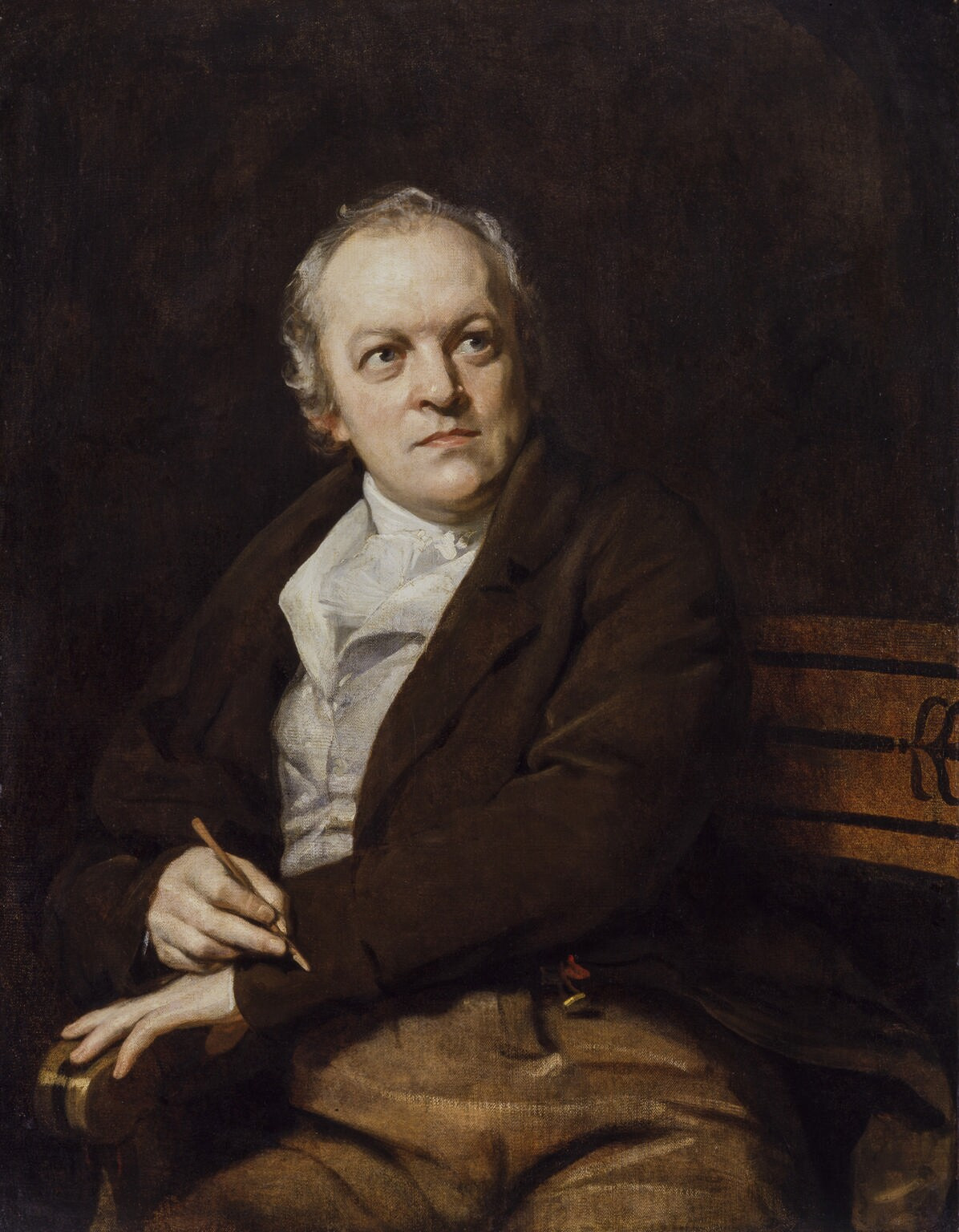
William Blake by Thomas Phillips.jpg


William Blake (28 November 1757 – 12 August 1827) was an English poet, painter, and printmaker. Largely unrecognised during his lifetime, Blake is now considered a seminal figure in the history of the poetry and visual arts of the Romantic Age. His so-called prophetic works were said by 20th century critic Northrop Frye to form "what is in proportion to its merits the least read body of poetry in the English language". His visual artistry led 21st-century critic Jonathan Jones to proclaim him "far and away the greatest artist Britain has ever produced". In 2002, Blake was placed at number 38 in the BBC's poll of the 100 Greatest Britons. Although he lived in London his entire life (except for three years spent in Felpham),he produced a diverse and symbolically rich œuvre, which embraced the imagination as "the body of God" or "human existence itself".

Although Blake was considered mad by contemporaries for his idiosyncratic views, he is held in high regard by later critics for his expressiveness and creativity, and for the philosophical and mystical undercurrents within his work. His paintings and poetry have been characterised as part of the Romantic movement and as "Pre-Romantic". Reverent of the Bible but hostile to the Church of England (indeed, to almost all forms of organised religion), Blake was influenced by the ideals and ambitions of the French and American Revolutions. Though later he rejected many of these political beliefs, he maintained an amiable relationship with the political activist Thomas Paine; he was also influenced by thinkers such as Emanuel Swedenborg.Despite these known influences, the singularity of Blake's work makes him difficult to classify. The 19th-century scholar William Rossetti characterised him as a "glorious luminary", and "a man not forestalled by predecessors, nor to be classed with contemporaries, nor to be replaced by known or readily surmisable successors".


John Donne

JohnDonne.jpg

John Donne was an English poet and cleric in the Church of England.

He is considered the pre-eminent representative of the metaphysical poets. His works are noted for their strong, sensual style and include sonnets, love poems, religious poems, Latin translations, epigrams, elegies, songs, satires and sermons. His poetry is noted for its vibrancy of language and inventiveness of metaphor, especially compared to that of his contemporaries. Donne's style is characterised by abrupt openings and various paradoxes, ironies and dislocations. These features, along with his frequent dramatic or everyday speech rhythms, his tense syntax and his tough eloquence, were both a reaction against the smoothness of conventional Elizabethan poetry and an adaptation into English of European baroque and mannerist techniques. His early career was marked by poetry that bore immense knowledge of English society and he met that knowledge with sharp criticism. Another important theme in Donne's poetry is the idea of true religion, something that he spent much time considering and about which he often theorized. He wrote secular poems as well as erotic and love poems. He is particularly famous for his mastery of metaphysical conceits.


Metaphysical poet

The term metaphysical poets was coined by the critic Samuel Johnson to describe a loose group of 17th-century English poets whose work was characterized by the inventive use of conceits, and by a greater emphasis on the spoken rather than lyrical quality of their verse. These poets were not formally affiliated and few were highly regarded until 20th century attention established their importance. Given the lack of coherence as a movement, and the diversity of style between poets, it has been suggested that calling them Baroque poets after their era might be more useful. Once the Metaphysical style was established, however, it was occasionally adopted by other and especially younger poets to fit appropriate circumstances.


Death, be not proud 
BY JOHN DONNE

Death, be not proud, though some have called thee 
Mighty and dreadful, for thou art not so; 
For those whom thou think'st thou dost overthrow 
Die not, poor Death, nor yet canst thou kill me. 
From rest and sleep, which but thy pictures be, 
Much pleasure; then from thee much more must flow, 
And soonest our best men with thee do go, 
Rest of their bones, and soul's delivery. 
Thou art slave to fate, chance, kings, and desperate men, 
And dost with poison, war, and sickness dwell, 
And poppy or charms can make us sleep as well 
And better than thy stroke; why swell'st thou then? 
One short sleep past, we wake eternally 
And death shall be no more; Death, thou shalt die. 

week 11

blank verse
Blank verse is poetry written with regular metrical but unrhymed lines, almost always in iambic pentameter. It has been described as "probably the most common and influential form that English poetry has taken since the 16th century", and Paul Fussell has estimated that "about three quarters of all English poetry is in blank verse".


couplet
Two consecutive lines of verse linked by rhyme and meter; the meter of a heroic couplet is iambic pentameter.


figurative language
language that uses figures of speech.


figure of speech
Any word or phrase that creates a "figure" in the mind of the reader by effecting an obvious change in the usual meaning or order of words, by comparing or identifying one thing with another; also called a trope. Metaphor, simile, metonymy, overstatement, oxymoron, and understatement are common figures of speech.

metaphor
It may provide clarity or identify hidden similarities between two ideas. Antithesis, hyperbole, metonymy and simile are all types of metaphor.One of the most commonly cited examples of a metaphor in English literature is the "All the world's a stage" monologue from As You Like It:

simile

A simile (/ˈsɪməli/) is a figure of speech that directly compares two things. Although similes and metaphors are similar, similes explicitly use connecting words (such as like, as, so, than, or various verbs such as resemble), though these specific words are not always necessary. While similes are mainly used in forms of poetry that compare the inanimate and the living, there are also terms in which similes and personifications are used for humorous purposes and comparison.


meter
the more or less regular pattern of stressed and unstressed syllables in a line of poetry. This is determined by the kind of foot (iambie or dactylic, for example) and by the number of feet per line.


octa-:eight
octave
 in poetry is a line of eight metrical feet. It is not very common in English verse.


ode
An ode is a type of lyrical stanza. A classic ode is structured in three major parts: the strophe, the antistrophe, and the epode. Different forms such as the homostrophic ode and the irregular ode also exist. It is an elaborately structured poem praising or glorifying an event or individual, describing nature intellectually as well as emotionally.


overstatement
exaggerated language; also called hyperbole.


poetry
One of the three major genres of imaginative literature, which has its origins in music and oral performance and is characterized by controlled patterns of rhythm and syntax( often using meter and rhyme ); compression and compactness and allowance for ambiguity; a particularly concentrated emphasis on the sensual, especially visual and aural, qualities and effects of words and word order; especially vivid, often figurative language. 


rhyme
A rhyme is a repetition of similar sounds (or the same sound) in two or more words, most often in the final syllables of lines in poems and songs. The word rhyme is also a pars pro toto ("a part (taken) for the whole") that means a short poem, such as a rhyming couplet or other brief rhyming poem such as nursery rhymes.


rhyme scheme
A rhyme scheme is the pattern of rhymes at the end of each line of a poem or song. It is usually referred to by using letters to indicate which lines rhyme; lines designated with the same letter all rhyme with each other.

An example of the "abab" rhyming scheme, from To Anthea, who may Command him Anything, written by Robert Herrick:

Bid me to weep, and I will weep                   a
While I have eyes to see                              b
And having none, yet I will keep                   a
A heart to weep for thee                               b


understatement
Understatement is a form of speech or disclosure which contains an expression of lesser strength than what would be expected. It is the opposite of an embellishment. The rhetorical form of understatement is litotes in which understatement is used for emphasis and irony. This is not to be confused with euphemism, where a polite phrase is used in place of a harsher or more offensive expression.

To Helen

(by Edger Allan Poe)

Helen, thy beauty is to me 
   Like those Nicéan barks of yore, 
That gently, o'er a perfumed sea, 
   The weary, way-worn wanderer bore 
   To his own native shore. 

On desperate seas long wont to roam, 
   Thy hyacinth hair, thy classic face, 
Thy Naiad airs have brought me home 
   To the glory that was Greece,       
   And the grandeur that was Rome. 

Lo! in yon brilliant window-niche 
   How statue-like I see thee stand, 
The agate lamp within thy hand! 
   Ah, Psyche, from the regions which 

   Are Holy-Land! 


The Lake Isle of Innisfree 
BY WILLIAM BUTLER YEATS

I will arise and go now, and go to Innisfree,
And a small cabin build there, of clay and wattles made;
Nine bean-rows will I have there, a hive for the honey-bee,
And live alone in the bee-loud glade.

And I shall have some peace there, for peace comes dropping slow,
Dropping from the veils of the morning to where the cricket sings;
There midnight’s all a glimmer, and noon a purple glow,
And evening full of the linnet’s wings.

I will arise and go now, for always night and day
I hear lake water lapping with low sounds by the shore;
While I stand on the roadway, or on the pavements grey,

I hear it in the deep heart’s core.


week 17

A Midsummer Night's Dream Characters Theseus—Duke of Athens Hippolyta—Queen of the Amazons Egeus—father of Hermia Hermia—daug...