BY ROBERT HERRICK
Gather ye rose-buds while ye may,
Old Time is still a-flying;
And this same flower that smiles today
Tomorrow will be dying.
The glorious lamp of heaven, the sun,
The higher he’s a-getting,
The sooner will his race be run,
And nearer he’s to setting.
That age is best which is the first,
When youth and blood are warmer;
But being spent, the worse, and worst
Times still succeed the former.
Then be not coy, but use your time,
And while ye may, go marry;
For having lost but once your prime,
You may forever tarry.
Cronus

In Greek mythology, Cronus, or Kronos, was the leader and youngest of the first generation of Titans, the divine descendants of Uranus, the sky, and Gaia, the earth. He overthrew his father and ruled during the mythological Golden Age, until he was overthrown by his own son Zeus and imprisoned in Tartarus. According to Plato, Phorcys, Cronus and Rhea were the eldest children of Oceanus and Tethys.
Cronus was usually depicted with a harpe, scythe or a sickle, which was the instrument he used to castrate and depose Uranus, his father. In Athens, on the twelfth day of the Attic month of Hekatombaion, a festival called Kronia was held in honour of Cronus to celebrate the harvest, suggesting that, as a result of his association with the virtuous Golden Age, Cronus continued to preside as a patron of harvest. Cronus was also identified in classical antiquity with the Roman deity Saturn.
Hypothesis
A hypothesis (plural hypotheses) is a proposed explanation for a phenomenon. For a hypothesis to be a scientific hypothesis, the scientific method requires that one can test it. Scientists generally base scientific hypotheses on previous observations that cannot satisfactorily be explained with the available scientific theories. Even though the words "hypothesis" and "theory" are often used synonymously, a scientific hypothesis is not the same as a scientific theory. A working hypothesis is a provisionally accepted hypothesis proposed for further research.
Carpe diem
'Carpe diem' is usually translated from the Latin as 'seize the day'. However, the more pedantic of Latin scholars may very well seize you by the throat if you suggest that translation. 'Carpe' translates literally as 'pluck', with particular reference to the picking of fruit, so a more accurate rendition is 'enjoy the day, pluck the day when it is ripe'. The extended version of the phrase 'carpe diem, quam minimum credula postero' translates as 'pluck the day, trusting as little as possible in the future'.
Brothers Grimm
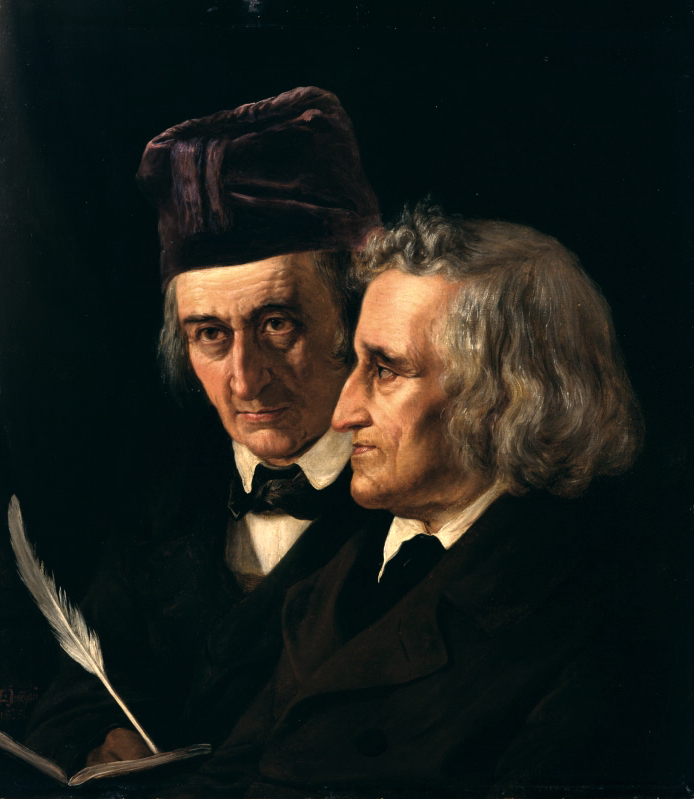
The Brothers Grimm , Jacob (1785–1863) and Wilhelm Grimm (1786–1859), were German academics, philologists, cultural researchers, lexicographers and authors who together specialized in collecting and publishing folklore during the 19th century. They were among the best-known storytellers of folk tales, and popularized stories such as "Cinderella" ("Aschenputtel"), "The Frog Prince" ("Der Froschkönig"), "The Goose-Girl" ("Die Gänsemagd"), "Hansel and Gretel" ("Hänsel und Gretel"), "Rapunzel", "Rumpelstiltskin" ("Rumpelstilzchen"),"Sleeping Beauty" ("Dornröschen"), and "Snow White" ("Schneewittchen"). Their first collection of folk tales, Children's and Household Tales (Kinder- und Hausmärchen), was published in 1812.
The Wolf and the Seven Young Goats
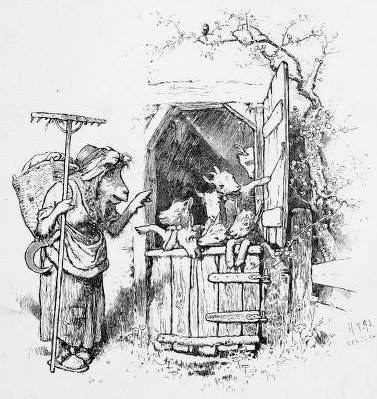
"The Wolf and the Seven Young Goats" (German: Der Wolf und die sieben jungen Geißlein) is a fairy tale collected by the Brothers Grimm, tale number 5. It is Aarne-Thompson type 123, but has a strong resemblance to The Three Little Pigs and other Aarne-Thomspson type 124 folktales, and to the variant of Little Red Riding Hood that the Grimms collected, where she is rescued.


沒有留言:
張貼留言