BY PERCY BYSSHE SHELLEY
O wild West Wind, thou breath of Autumn's being,
Thou, from whose unseen presence the leaves dead
Are driven, like ghosts from an enchanter fleeing,
Yellow, and black, and pale, and hectic red,
Pestilence-stricken multitudes: O thou,
Who chariotest to their dark wintry bed
The winged seeds, where they lie cold and low,
Each like a corpse within its grave, until
Thine azure sister of the Spring shall blow
Her clarion o'er the dreaming earth, and fill
(Driving sweet buds like flocks to feed in air)
With living hues and odours plain and hill:
Wild Spirit, which art moving everywhere;
Destroyer and preserver; hear, oh hear!

→"Ode to the West Wind" is an ode, written by Percy Bysshe Shelley in 1819 near Florence, Italy. It was originally published in 1820 by Charles and Edmund Ollier in London as part of the collection Prometheus Unbound, A Lyrical Drama in Four Acts, With Other Poems. Some have interpreted the poem as the speaker lamenting his inability to directly help those in England owing to his being in Italy. At the same time, the poem expresses the hope that its words will inspire and influence those who read or hear it. Perhaps more than anything else, Shelley wanted his message of reform and revolution spread, and the wind becomes the trope for spreading the word of change through the poet-prophet figure. Some also believe that the poem was written in response to the loss of his son, William (born to Mary Shelley) in 1819. The ensuing pain influenced Shelley. The poem allegorises the role of the poet as the voice of change and revolution. At the time of composing this poem, Shelley without doubt had the Peterloo Massacre of August 1819 in mind. His other poems written at the same time—The Masque of Anarchy, Prometheus Unbound, and "England in 1819"—take up these same themes of political change, revolution, and role of the poet.
The Tyger
BY WILLIAM BLAKE
Tyger Tyger, burning bright,
In the forests of the night;
What immortal hand or eye,
Could frame thy fearful symmetry?
In what distant deeps or skies.
Burnt the fire of thine eyes?
On what wings dare he aspire?
What the hand, dare seize the fire?
And what shoulder, & what art,
Could twist the sinews of thy heart?
And when thy heart began to beat,
What dread hand? & what dread feet?
What the hammer? what the chain,
In what furnace was thy brain?
What the anvil? what dread grasp,
Dare its deadly terrors clasp!
When the stars threw down their spears
And water'd heaven with their tears:
Did he smile his work to see?
Did he who made the Lamb make thee?
Tyger Tyger burning bright,
In the forests of the night:
What immortal hand or eye,
Dare frame thy fearful symmetry?
William Blake
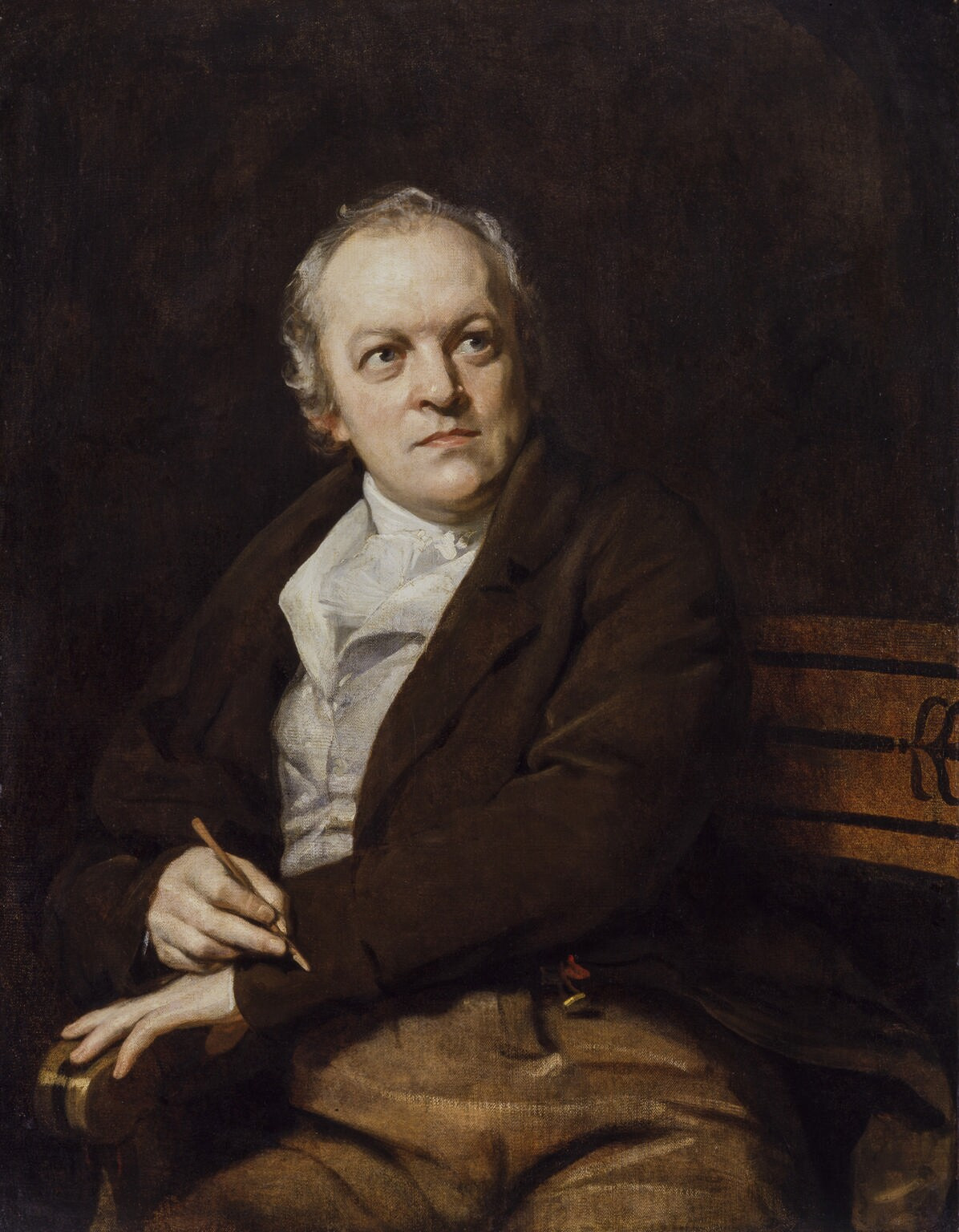
William Blake (28 November 1757 – 12 August 1827) was an English poet, painter, and printmaker. Largely unrecognised during his lifetime, Blake is now considered a seminal figure in the history of the poetry and visual arts of the Romantic Age. His so-called prophetic works were said by 20th century critic Northrop Frye to form "what is in proportion to its merits the least read body of poetry in the English language". His visual artistry led 21st-century critic Jonathan Jones to proclaim him "far and away the greatest artist Britain has ever produced". In 2002, Blake was placed at number 38 in the BBC's poll of the 100 Greatest Britons. Although he lived in London his entire life (except for three years spent in Felpham),he produced a diverse and symbolically rich œuvre, which embraced the imagination as "the body of God" or "human existence itself".
Although Blake was considered mad by contemporaries for his idiosyncratic views, he is held in high regard by later critics for his expressiveness and creativity, and for the philosophical and mystical undercurrents within his work. His paintings and poetry have been characterised as part of the Romantic movement and as "Pre-Romantic". Reverent of the Bible but hostile to the Church of England (indeed, to almost all forms of organised religion), Blake was influenced by the ideals and ambitions of the French and American Revolutions. Though later he rejected many of these political beliefs, he maintained an amiable relationship with the political activist Thomas Paine; he was also influenced by thinkers such as Emanuel Swedenborg.Despite these known influences, the singularity of Blake's work makes him difficult to classify. The 19th-century scholar William Rossetti characterised him as a "glorious luminary", and "a man not forestalled by predecessors, nor to be classed with contemporaries, nor to be replaced by known or readily surmisable successors".
John Donne

John Donne was an English poet and cleric in the Church of England.
He is considered the pre-eminent representative of the metaphysical poets. His works are noted for their strong, sensual style and include sonnets, love poems, religious poems, Latin translations, epigrams, elegies, songs, satires and sermons. His poetry is noted for its vibrancy of language and inventiveness of metaphor, especially compared to that of his contemporaries. Donne's style is characterised by abrupt openings and various paradoxes, ironies and dislocations. These features, along with his frequent dramatic or everyday speech rhythms, his tense syntax and his tough eloquence, were both a reaction against the smoothness of conventional Elizabethan poetry and an adaptation into English of European baroque and mannerist techniques. His early career was marked by poetry that bore immense knowledge of English society and he met that knowledge with sharp criticism. Another important theme in Donne's poetry is the idea of true religion, something that he spent much time considering and about which he often theorized. He wrote secular poems as well as erotic and love poems. He is particularly famous for his mastery of metaphysical conceits.
Metaphysical poet
The term metaphysical poets was coined by the critic Samuel Johnson to describe a loose group of 17th-century English poets whose work was characterized by the inventive use of conceits, and by a greater emphasis on the spoken rather than lyrical quality of their verse. These poets were not formally affiliated and few were highly regarded until 20th century attention established their importance. Given the lack of coherence as a movement, and the diversity of style between poets, it has been suggested that calling them Baroque poets after their era might be more useful. Once the Metaphysical style was established, however, it was occasionally adopted by other and especially younger poets to fit appropriate circumstances.
Death, be not proud
BY JOHN DONNE
Death, be not proud, though some have called thee
Mighty and dreadful, for thou art not so;
For those whom thou think'st thou dost overthrow
Die not, poor Death, nor yet canst thou kill me.
From rest and sleep, which but thy pictures be,
Much pleasure; then from thee much more must flow,
And soonest our best men with thee do go,
Rest of their bones, and soul's delivery.
Thou art slave to fate, chance, kings, and desperate men,
And dost with poison, war, and sickness dwell,
And poppy or charms can make us sleep as well
And better than thy stroke; why swell'st thou then?
One short sleep past, we wake eternally
And death shall be no more; Death, thou shalt die.


沒有留言:
張貼留言