
A cathedral is a Christian church which contains the seat of a bishop, thus serving as the central church of a diocese, conference, or episcopate. The counterpart term for such a church in German is Dom from Latin domus ecclesiae or domus episcopalis; also Italian Duomo, Dutch Domkerk and cognates in many other European languages. Churches with the function of "cathedral" are usually specific to those Christian denominations with an episcopal hierarchy, such as the Roman Catholic, Anglican, Orthodox, and some Lutheran and Methodist churches. Church buildings embodying the functions of a cathedral first appear in Italy, Gaul, Spain and North Africa in the 4th century, but cathedrals did not become universal within the Western Catholic Church until the 12th century, by which time they had developed architectural forms, institutional structures and legal identities distinct from parish churches, monastic churches and episcopal residences.
In respect of the church buildings in the Eastern Orthodox Church, the English word "cathedral" commonly translates katholikon (sobor in Slavic languages), meaning of "assembly"; but this title is also applied to monastic and other major churches without episcopal responsibilities. When the church at which an archbishop or "metropolitan" presides is specifically intended, the term kathedrikos naos (literally: "cathedral church") is used.
Following the Protestant Reformation, the Christian church in several parts of Western Europe, such as Scotland, the Netherlands, certain Swiss Cantons and parts of Germany, adopted a Presbyterian polity that did away with bishops altogether. Where ancient cathedral buildings in these lands are still in use for congregational worship, they generally retain the title and dignity of "cathedral", maintaining and developing distinct cathedral functions, but void of hierarchical supremacy. From the 16th century onwards, but especially since the 19th century, churches originating in Western Europe have undertaken vigorous programmes of missionary activity, leading to the founding of large numbers of new dioceses with associated cathedral establishments of varying forms in Asia, Africa, Australasia, Oceania and the Americas. In addition, both the Catholic Church and Orthodox churches have formed new dioceses within formerly Protestant lands for converts and migrant co-religionists. Consequently, it is not uncommon to find Christians in a single city being served by three or more cathedrals of differing denominations.
Beowulf

Beowulf is an Old English epic poem consisting of 3,182 alliterative lines. It may be the oldest surviving long poem in Old English and is commonly cited as one of the most important works of Old English literature. A date of composition is a matter of contention among scholars; the only certain dating pertains to the manuscript, which was produced between 975 and 1025. The author was an anonymous Anglo-Saxon poet, referred to by scholars as the "Beowulf poet".
The poem is set in Scandinavia. Beowulf, a hero of the Geats, comes to the aid of Hrothgar, the king of the Danes, whose mead hall in Heorot has been under attack by a monster known as Grendel. After Beowulf slays him, Grendel's mother attacks the hall and is then also defeated. Victorious, Beowulf goes home to Geatland (Götaland in modern Sweden) and later becomes king of the Geats. After a period of fifty years has passed, Beowulf defeats a dragon, but is fatally wounded in the battle. After his death, his attendants cremate his body and erect a tower on a headland in his memory.
The full poem survives in the manuscript known as the Nowell Codex. It has no title in the original manuscript, but has become known by the name of the story's protagonist. In 1731, the manuscript was badly damaged by a fire that swept through Ashburnham House in London that had a collection of medieval manuscripts assembled by Sir Robert Bruce Cotton. The Nowell Codex is currently housed in the British Library.
George Orwell
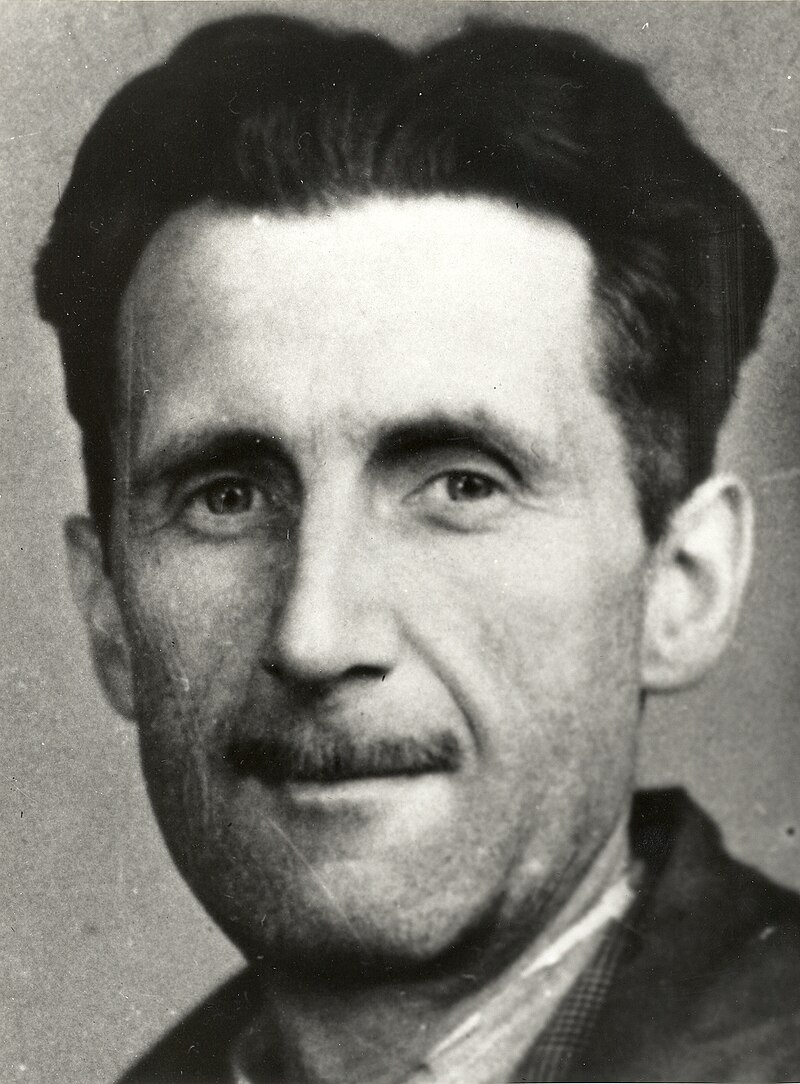
Eric Arthur Blair (25 June 1903 – 21 January 1950), better known by his pen name George Orwell, was an English novelist, essayist, journalist, and critic. His work is marked by lucid prose, awareness of social injustice, opposition to totalitarianism, and outspoken support of democratic socialism.
Orwell wrote literary criticism, poetry, fiction, and polemical journalism. He is best known for the allegorical novella Animal Farm (1945) and the dystopian novel Nineteen Eighty-Four (1949). His non-fiction works, including The Road to Wigan Pier (1937), documenting his experience of working class life in the north of England, and Homage to Catalonia (1938), an account of his experiences in the Spanish Civil War, are widely acclaimed, as are his essays on politics, literature, language, and culture. In 2008, The Times ranked him second on a list of "The 50 greatest British writers since 1945".
Orwell's work continues to influence popular and political culture, and the term Orwellian – descriptive of totalitarian or authoritarian social practices – has entered the language together with many of his neologisms, including cold war, Big Brother, Thought Police, Room 101, memory hole, newspeak, doublethink, and thoughtcrime.
Colosseum

The Colosseum or Coliseum , also known as the Flavian Amphitheatre (Latin: Amphitheatrum Flavium; Italian: Anfiteatro Flavio [aŋfiteˈaːtro ˈflaːvjo] or Colosseo [kolosˈsɛːo]), is an oval amphitheatre in the centre of the city of Rome, Italy. Built of concrete and sand,[1] it is the largest amphitheatre ever built. The Colosseum is situated just east of the Roman Forum. Construction began under the emperor Vespasian in AD 72, and was completed in AD 80 under his successor and heir Titus. Further modifications were made during the reign of Domitian (81–96). These three emperors are known as the Flavian dynasty, and the amphitheatre was named in Latin for its association with their family name (Flavius).
The Colosseum could hold, it is estimated, between 50,000 and 80,000 spectators, having an average audience of some 65,000; it was used for gladiatorial contests and public spectacles such as mock sea battles (for only a short time as the hypogeum was soon filled in with mechanisms to support the other activities), animal hunts, executions, re-enactments of famous battles, and dramas based on Classical mythology. The building ceased to be used for entertainment in the early medieval era. It was later reused for such purposes as housing, workshops, quarters for a religious order, a fortress, a quarry, and a Christian shrine.
Although partially ruined because of damage caused by earthquakes and stone-robbers, the Colosseum is still an iconic symbol of Imperial Rome. It is one of Rome's most popular tourist attractions and also has links to the Roman Catholic Church, as each Good Friday the Pope leads a torchlit "Way of the Cross" procession that starts in the area around the Colosseum.


沒有留言:
張貼留言