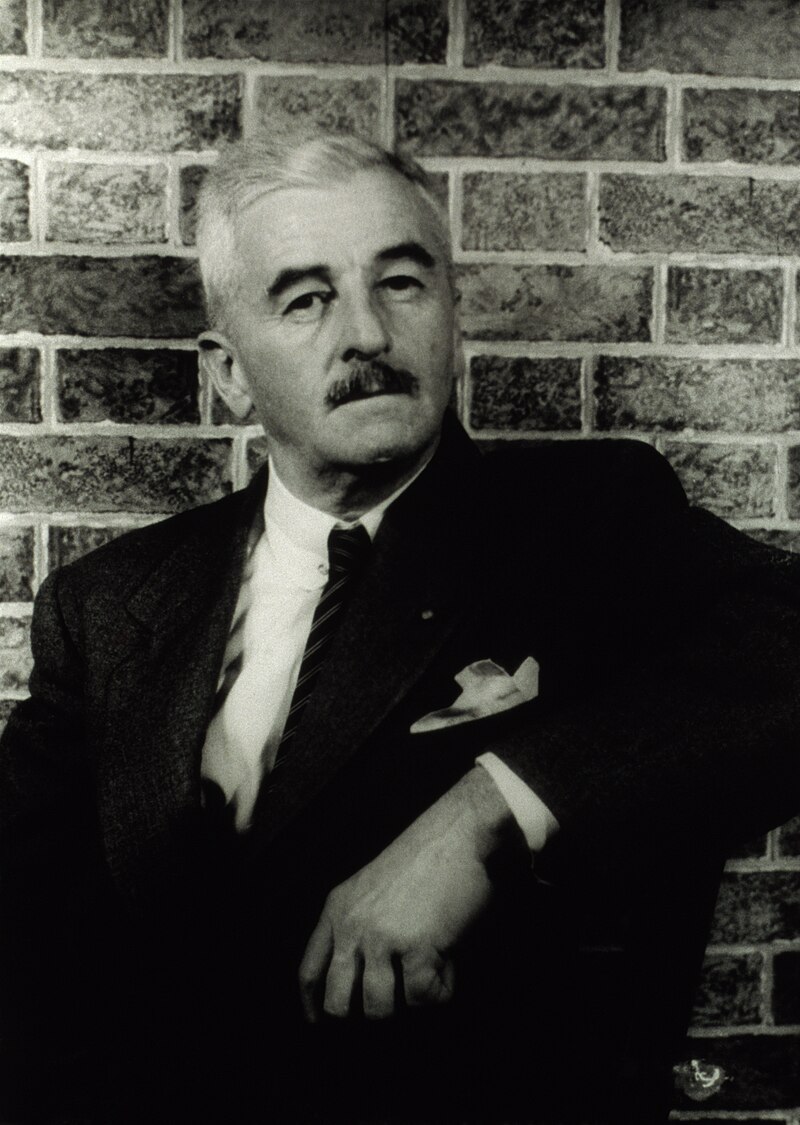
William Cuthbert Faulkner was an American writer and Nobel Prize laureate from Oxford, Mississippi. Faulkner wrote novels, short stories, a play, poetry, essays, and screenplays. He is primarily known for his novels and short stories set in the fictional Yoknapatawpha County, based on Lafayette County, Mississippi, where he spent most of his life.
Faulkner is one of the most celebrated writers in American literature generally and Southern literature specifically. Though his work was published as early as 1919, and largely during the 1920s and 1930s, Faulkner was relatively unknown until receiving the 1949 Nobel Prize in Literature, for which he became the only Mississippi-born Nobel winner. Two of his works, A Fable (1954) and his last novel The Reivers (1962), won the Pulitzer Prize for Fiction. In 1998, the Modern Library ranked his 1929 novel The Sound and the Fury sixth on its list of the 100 best English-language novels of the 20th century; also on the list were As I Lay Dying (1930) and Light in August (1932). Absalom, Absalom! (1936) is often included on similar lists.
A Rose for Emily
"A Rose for Emily" is a short story by American author William Faulkner, first published in the April 30, 1930, issue of The Forum. The story takes place in Faulkner's fictional city, Jefferson, Mississippi, in the fictional southern town of Yoknapatawpha County. It was Faulkner's first short story published in a national magazine.
→Plot summary
The story opens with a brief first-person account of the funeral of Emily Grierson, an elderly Southern woman whose funeral is the obligation of their small town. It then proceeds in a non-linear fashion to the narrator's recollections of Emily's archaic and increasingly strange behavior throughout the years. Emily is a member of a family of the antebellum Southern aristocracy. After the Civil War, the family has fallen on hard times. She and her father, the last two of the clan, continue to live as if in the past; Emily’s father refuses for her to marry. Her father dies when Emily is about the age of 30, and takes her by surprise. She refused to give up his corpse, and the townspeople wrote it off as her grieving process.
After her acceptance of her father's death, Emily somewhat revives; she becomes friendly with Homer Barron, a Northern laborer who comes to town shortly after Mr. Grierson’s death. The connection surprises some of the community while others are glad she is taking an interest. But Homer claims that he is not a marrying man—a bachelor. Emily shortly buys arsenic from a druggist in town, which convinces the townspeople she was to poison herself with it. Emily’s distant cousins are called into town by the minister’s wife to supervise Miss Emily and Homer Barron. Homer leaves town for some time, reputedly to give Emily a chance to get rid of her cousins, and returns three days later after the cousins have left. Homer is never seen again.
Despite these turnabouts in her social status, Emily continues to behave haughtily, as she had before her father died. Her reputation is such that the city council finds themselves unable to confront her about a strong smell that has begun to emanate from the house. Instead, they decide to send men to her house under the cover of darkness to sprinkle lime around the house, after which the smell dissipates. The mayor of the town, Colonel Sartoris, made a gentleman's agreement to overlook her taxes as an act of charity, though it was done under a pretense of repayment towards her father to assuage Emily's pride after her father had died. Years later, when the next generation has come to power, Emily insists on this informal arrangement, flatly refusing that she owes any taxes; the council declines to press the issue. Emily has become a recluse: she is never seen out of the house, and only rarely accepts people into it. The community comes to view her as a "hereditary obligation" on the town, who must be humored and tolerated.
The funeral is a large affair; Emily had become an institution, so her death sparks a great deal of curiosity about her reclusive nature and what remains of her house. After she is buried, a group of townsfolk enters her house to see what remains of her life there. The door to her upstairs bedroom is locked; some of the townsfolk kick in the door to see what has been hidden for so long. Inside, among the possessions that Emily had bought for Homer, lies the decomposed corpse of Homer Barron on the bed; on the pillow beside him is the indentation of a head and a single strand of Emily's gray hair.
Anton Chekhov
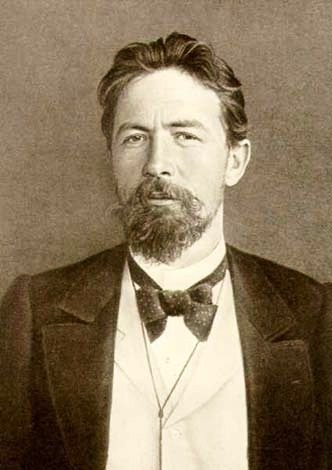
Anton Pavlovich Chekhov was a Russian playwright and short story writer, who is considered to be among the greatest writers of short fiction in history. His career as a playwright produced four classics and his best short stories are held in high esteem by writers and critics.Along with Henrik Ibsen and August Strindberg, Chekhov is often referred to as one of the three seminal figures in the birth of early modernism in the theatre. Chekhov practiced as a medical doctor throughout most of his literary career: "Medicine is my lawful wife", he once said, "and literature is my mistress."
Chekhov renounced the theatre after the reception of The Seagull in 1896, but the play was revived to acclaim in 1898 by Konstantin Stanislavski's Moscow Art Theatre, which subsequently also produced Chekhov's Uncle Vanya and premiered his last two plays, Three Sisters and The Cherry Orchard. These four works present a challenge to the acting ensemble as well as to audiences, because in place of conventional action Chekhov offers a "theatre of mood" and a "submerged life in the text".
Chekhov had at first written stories only for financial gain, but as his artistic ambition grew, he made formal innovations which have influenced the evolution of the modern short story. He made no apologies for the difficulties this posed to readers, insisting that the role of an artist was to ask questions, not to answer them.
The Lady with the Dog
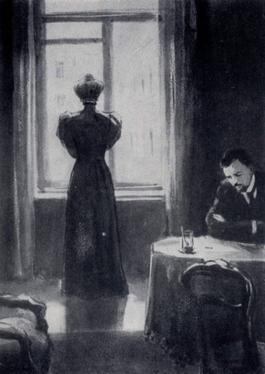
"The Lady with the Dog" is a short story by Anton Chekhov first published in 1899. It tells the story of an adulterous affair between a Russian banker and a young lady he meets while vacationing in Yalta. The story comprises four parts: part I describes the initial meeting in Yalta, part II the consummation of the affair and the remaining time in Yalta, part III Gurov's return to Moscow and his visit to Anna's town, and part IV Anna's visits to Moscow. One of Chekhov's most famous pieces of short fiction, Vladimir Nabokov declared that it was one of the greatest short stories ever written.


沒有留言:
張貼留言